Curriculum
Trivium University is a graduate-level, non-credit
certificate program. It consists of four
core and multiple elective courses, all composed of the close-reading of
preassigned texts, conducted via seminars online. In addition, there will be cross-course group
discussions and geography-based in-person meetings.
To apply for Trivium University – which
begins with a “beta-test” of Course #1 in the summer of 2023 and continues with
a full 4-course schedule in the fall 2023 -- please send an email to This email address is being protected from spambots. You need JavaScript enabled to view it.
Core Curriculum (all
four required)
Course
#1: Crisis & Causality – Ancients
vs. Moderns
Seminar
#1: The Multi-Crises: Modernity,
Meaning, Globalism
Seminar
#2: Paradigms: Oral, Scribal, [Print],
[Electric], Digital (Introduction)
Seminar
#3: Cause & Causality: Forms and the
Immaterial
Seminar
#4: Sensibilities and the Inner Senses
(Introduction)
Seminar
#5: Towards the Good: Meaning of Life
Seminar
#6: Three Spheres: East, West and
Digital (Introduction)
Seminar
#7: Robots: What Does It Mean to Be
Human?
Seminar
#8: Restoration of Humanity: Retrieving
the Scribal
Course
#2: Paradigms & Technology
Course
#3: Inner
Senses and the Digital Paradigm
Course #4:
Three Spheres: East, West, and Digital
Electives (at least four required)
Elective #1:
Grammar: Understanding Reality
Elective #2:
Rhetoric: True Speech
Elective #3:
Dialectics: What the World Might Become
Elective #4:
Net Assessment & Strategy
Elective #5:
The Tetrad & Exegesis
Elective #6:
Aristotle & Plato
Elective #7:
Aquinas & Bonaventure
Elective #8:
Semiotics & Language
Elective #9:
New Sciences & Natural Law
Elective #10: Digital Governance &
Subsidiarity
Elective #11: Evil & Gnosis
Trivium University's curriculum is experimental – making us all new-era scientists. We have embarked on this effort to both encourage curiosity as well as instill self-confidence in exploring our new Digital paradigm. We approach this with humility and a strong sense of responsibility for the experimental outcomes. Digital technology has already upended our world. Nothing seems “quite right” anymore. Old approaches seem inadequate and old categories no longer seem to apply. We do not bring a particular political or religious agenda to this exploration; although neither can be ignored.
The history of our effort goes back decades, involving many influences and participants. Outside of specialized academic research, the Trivium is rarely discussed today. Projects like “Great Books” set out to build a canon that centered in the Print paradigm (to which it may have hoped we could return). As a result of today's digitally-provoked multi-crisis, a traditional Great Books education will not provide us with the depth and resources to confront today's opportunities/challenges. Our heritage isn't so much pedagogical as it is “all-things-considered,” not the approach of narrow disciplines. Accordingly, we will explore heuristics that do not normally come up in graduate education. Our goal is to stimulate new/old ways of thinking, while learning more about ourselves in the process.

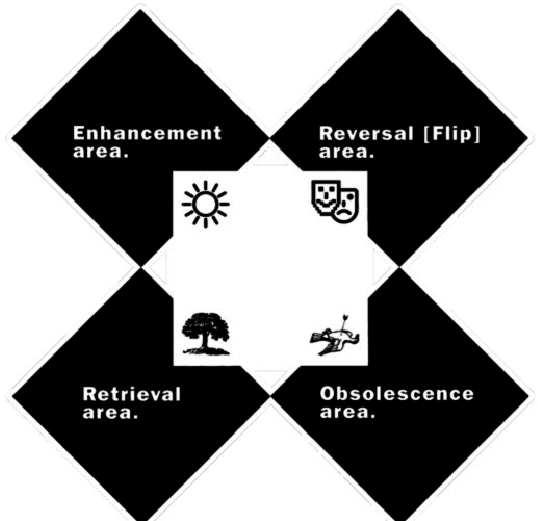
Where has this been done before? There have been, of course, many attempts at “unorthodox” and even “extreme” education. Monasteries and battlefields come to mind. In our case, we will focus on techniques that attempt to reverse the sliding into specialized knowledge silos and, instead, aim to provide a more comprehensive overview. Specifically, we are focusing on two recent additions to the list of all-around approaches: Net Assessment and the Tetrad. Net Assessment comes from the Pentagon's top-level think tank, largely developed by its founder, Andrew Marshall, in the 1970s/80s. The Tetrad was developed in the 1970s by the father-son pair of Marshall and Eric McLuhan. In both cases, the severe limits of earlier approaches combined with pressing urgency proved that necessity generates invention. We are the first to apply these heuristics to the Digital paradigm, thus our commitment to learning in the process.